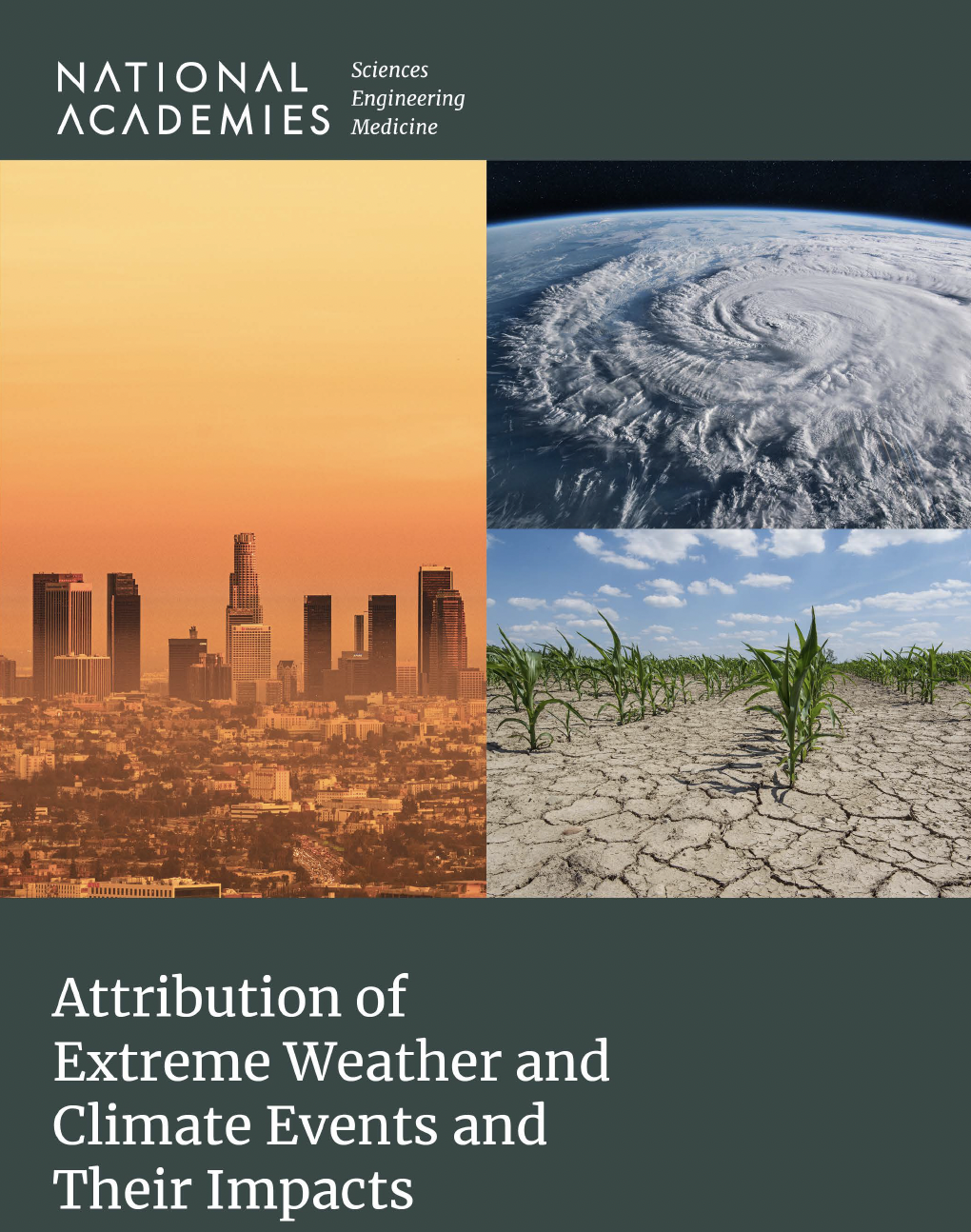
The National Academy of Sciences has put out a new report assessing the state of understanding of the science of extreme weather attribution, an area of climate science developed in recent decades that allows us to assess the degree to which climate change is already having a demonstrable impact on the frequency and severity of extreme weather events.
The report contains an unambiguous, affirmative statement that human-caused climate change is indeed impacting the occurrence and intensity of extreme weather events. The Executive Summary plainly states (without the usual hemming and hawing):
Decades of data and research indicate that human-caused climate change is altering the frequency and intensity of several types of extreme weather events, such as hurricanes, record-breaking heat waves, and extreme rainfall.
I’ve written about these connections extensively over the past several years. See for example my July 2021 op-ed “Wildfires, floods and extreme heat: It is time to heed warnings from climate scientists” (The Hill), my September 2022 op-ed with Susan Joy Hassol “Hurricane Ian is no anomaly. The climate crisis is making storms more powerful (The Guardian) or my June 2023 op-ed with Susan Joy Hassol “This heatwave is a climate omen. But it’s not too late to change course” (The Guardian).
The new report makes clear that the stronger conclusions that can now be reached regarding the impact that climate change is having on extreme weather events is a direct result of substantial progress in the science, and in particular, the developments over the past decade in the science of Extreme Event Attribution (EEA), which allows scientists to characterize the extent to which climate change likely intensified or altered the characteristics of any particular extreme weather event:
The scientific tools, observational datasets, and methods developed and used for EEA have advanced considerably over the past decade and increased the confidence in EEA results
The robust conclusions that have been reached by the mainstream climate research community betray the dismissive claims that continue to be made by fossil fuel industry groups, right wing think tanks and Republican operatives who who feel threatened by the scientific progress in this particular area. They have long understood (as I discuss at length in my 2016 book The Madhouse Effect with Washington Post cartoonist Tom Toles) that Americans will increasingly demand meaningful policy action on climate as they come to understand the profound role that fossil fuel burning is playing in the worsening climate crisis. Nothing connects the dots better that the increasingly dangerous, damaging and deadly climate change-fueled extreme weather events. As an aside, I could see and smell the hazardous wildfire smoke that blanketed the northeastern U.S. while on vacation with my family in New Hampshire this week. Increasingly, Americans are connecting the dots between our reliance on fossil fuels and the hazards we face, whether its costly and dangerous wars of choice in far-flung lands like Iran, or the threat of increasingly extreme weather events.
As Politico reported more than a month ago, the usual suspects have been preparing an assault on this report when it is set to appear. The fossil fuel industry front group Argus Insights has been harassing the report authors and making vexatious demands of them to both hamper their ability to write an objective report and generate conflict and controversy that they can use in their efforts to undermine public faith in the science (it’s part and parcel of a larger assault on science by vested interests that Peter Hotez and I wrote about at length in our recent book Science Under Siege):
Argus sought the internal communications of the panel’s chair and other members. The firm also requested potential emails the panelists might have exchanged with academics and lawyers who are developing legal strategies that could force oil, gas and coal companies to offset the growing economic toll of climate change.
Of particular note here is the role played by Roger Pielke Jr, who has long been engaged in attacks on climate science and climate scientists (including impugning their motives) that serve the interests of polluters. Pielke, in particular, has for decades now been attacking the science linking climate change to extreme weather disasters. His work has been heavily criticized by mainstream researchers (see e.g. “Roger Pielke Jr.’s Appallingly Bad Analysis of Billion Dollar Disasters” by political economist Blair Fix). Indeed, his dismissive inaugural article in March 2014 (“Disasters Cost More Than Ever — But Not Because of Climate Change.”) as a new commentator for Nate Silver’s site FiveThirtyEight.com, and his antics in lashing out against scientists (including myself) who were critical of the article, were so egregious that Nate Silver personally apologized on his behalf.
As the Huffington Post noted:
In “The Daily Show” interview, Jon Stewart asked Silver about the issue. Silver acknowledged hearing “a lot of concern from our readers” about Pielke’s article and said that about 80 percent of commenters “weighed in negatively.” As a result, Silver told Stewart that the site is commissioning a rebuttal.
(you can read about the rebuttal here, as well as other critiques of Pielke’s piece here, here, and here).
Pielke was out a few months later.
But that hardly stopped him. More than a decade later, Pielke has left academia for a position at a conservative think tank funded by the Koch Brothers and other right-leaning plutocrats, the American Enterprise Institute (AEI). In this capacity, he has played a central role in the ongoing right-wing assault on climate science and climate scientists, and has been the principle critic of the new National Academy study. As the Politico article cited earlier notes (see also this related piece in Politico‘s E&E News):
The obscure panel has faced online criticism from the American Enterprise Institute, a right-leaning think tank, and other groups bankrolled by the fossil fuel industry. On the day of its first meeting in 2024, AEI scholar Roger Pielke Jr. published a Substack post accusing the National Academies of engaging in “stealth advocacy in support of climate litigation.”
This is an example of a long-known strategy of bad actors in the climate space that is tantamount to what’s known is the sports world as “working the refs”. As researchers Stephan Lewandowsky, Naomi Oreskes and co-authors have demonstrated in peer-reviewed research, contrarian public framing by “vested interests and political agents” who “have long opposed political or regulatory action in response to climate change…may cause scientists to take positions that they would be less likely to take in the absence of outspoken public opposition.” The phenomenon is know as “seepage” as it descries how denialist memes, framing and thinking leak out, perhaps subconsciously, into the thinking, framing, and writings of mainstream scientists.
And there’s some evidence the attacks have been successful with the new NAS report, which comes out at a time when there is an unprecedented assault on science by the Trump administration and GOP, particularly when it comes to the science of climate change.
To be clear, the report is overall a comprehensive and objective assessment of the latest science on EEA and, more generally, the linkages between climate change and extreme weather events. The report authors comprise a blue ribbon panel of highly respected leading experts, and the report does an excellent job detailing both areas of emerging consensus and remaining areas of uncertainty.
However, I would argue that the report’s conclusions–in places–are more conservative and more tentative than the science objectively dictates, possibly a consequence of subconscious “seepage” on the part of the report authors.
Let me use an example from some of my own research, which is discussed briefly in the report.
It involves a body of work we have published in recent years (see e.g. here, here and here) characterizing how climate change impacts the behavior of the Northern Hemisphere summer jet stream. The basic impacts of climate change on extreme weather events are fairly easy to understand. A hotter planet will obviously yield more frequent and intense heat waves. And warmer oceans evaporate more moisture into the atmosphere, fueling more intense flooding events and stronger hurricanes (which feed on that moisture). Finally, warmer soils evaporate more moisture in the summer, leading more frequent and intense droughts in many regions.
But our work shows that there’s an additional dynamical factor. As the planet heats up due to carbon pollution and the Arctic warms faster than lower latitudes (due for example to melting ice), the contrast between the cold Arctic and warm subtropics decreases. But the jet stream exists because of that contrast. The contrast is already weakest in the summer, and this effect adds further to that, leading to an especially weak jet stream. A weak jet stream allows the wave-like undulations of the jet stream (which are associated with surface high and low pressure systems) to deepen and get stuck in place. A deep persistent high pressure system leads to days on end of heat, drought, and potentially wildfire (think “heat domes”). A persistent low pressure system leads to excessive rainfall (think extended floods). Our work shows that the changing latitudinal temperature patterns associated with human-caused warming favors this phenomenon, known as quasi-resonant amplification or “QRA”. You can read more about it it in this Scientific American article I wrote some years ago.
A recent study of ours in the Proceedings of the National Academy of Sciences showed that the incidence of QRA events has tripled (from roughly one QRA event per summer to roughly three events per summer) over the past half century.
Moreover, we showed that this increase is connected to two key features of human-caused climate: the aforementioed reduction of the equator-to-pole temperature gradient, and an increase in land/sea contrast. As we note in the study:
We demonstrate a tripling in the frequency of planetary wave resonance events over the past half century, coinciding with the rise in persistent boreal summer weather extremes. This increase aligns with changes in the underlying climate conditions favoring these events, including amplified Arctic warming and land–sea thermal contrast.
and:
Implicated mechanisms include amplified summer Arctic surface warming and increases in land–sea thermal contrast, favoring resonant planetary wave behavior, both of which have been linked to anthropogenic climate change.
Our QRA work (cited as Li et al, 2025b on page 69 in the report) is noted in the report, but the strength of our conclusions, in my view, are mischaracterized. The report states:
these dynamical changes [increased incidence of QRA] have not yet been definitively linked to anthropogenic warming
I suppose it all hinges on what one means by “definitively linked”, but the implication that a climate change connection hasn’t been established is misleading, given the conclusions from our study cited above.
The NAS report statement notes, appropriately, that models don’t capture some key dynamical effects (which includes QRA) and that this is a source of uncertainty:
Significant challenges remain, however, including structural limitations of the process based models used in EEA studies, temporal and geographic limitations of observations, and understanding how dynamic—not just thermodynamic—drivers of extreme events might respond to climate change.
However, the phrasing makes it sound like uncertainty is a reason to cast some doubt on the robustness of climate/extreme weather connections. Our own work has shown that current generation climate models used in EEA tend to do a poor job overall in capturing the phenomenon of QRA. Since the models are failing to capture one key mechanism that has been implicated in many of the most prominent persistent summer weather extremes in recent years (e.g. the 2003 European heatwave, the simultaneous 2010 Russian heatwave and Pakistan flooding, the 2016 Alberta wildfires, and the 2021 Pacific Northwest heat dome event), the conventional EEA studies are almost certainly underestimating the impact that climate change is having, and will have in the future, on persistent summer weather extremes.
The authors–in other words–have once again erred on the side of “least drama”.
The problem is that when scientists understate conclusions to avoid conflict or attacks from antiscience bad actors, it creates an asymmetry in our public discourse. Climate deniers and delayers attempt to undermine public understanding of what the science has to say, and scientists, potentially falling victim to “seepage”, don’t provide a full-throated enough defense of the science.
