
Research from climate scientist Michael Mann, Presidential Distinguished Professor of Earth and Environmental Science, and colleagues vindicates climate models and reframes the record heat of 2024.
By Marilyn Perkins
[this is an enhanced version of an article to appear in Penn’s Omnia magazine, with additional hyperlinks]
In 2023 and 2024, global temperatures reached a new high. The World Meteorological Organization declared 2024 the hottest year on record as extreme heatwaves, devastating floods, and ferocious wildfires continued to sweep across the globe. The surge prompted some scientists and journalists to suggest that the warming of the planet was not explicable.
But Michael Mann, Presidential Distinguished Professor of Earth and Environmental Science, wasn’t convinced. “That framing is unfortunate,” he says. “It makes it sound like we don’t understand what’s driving climate change.”
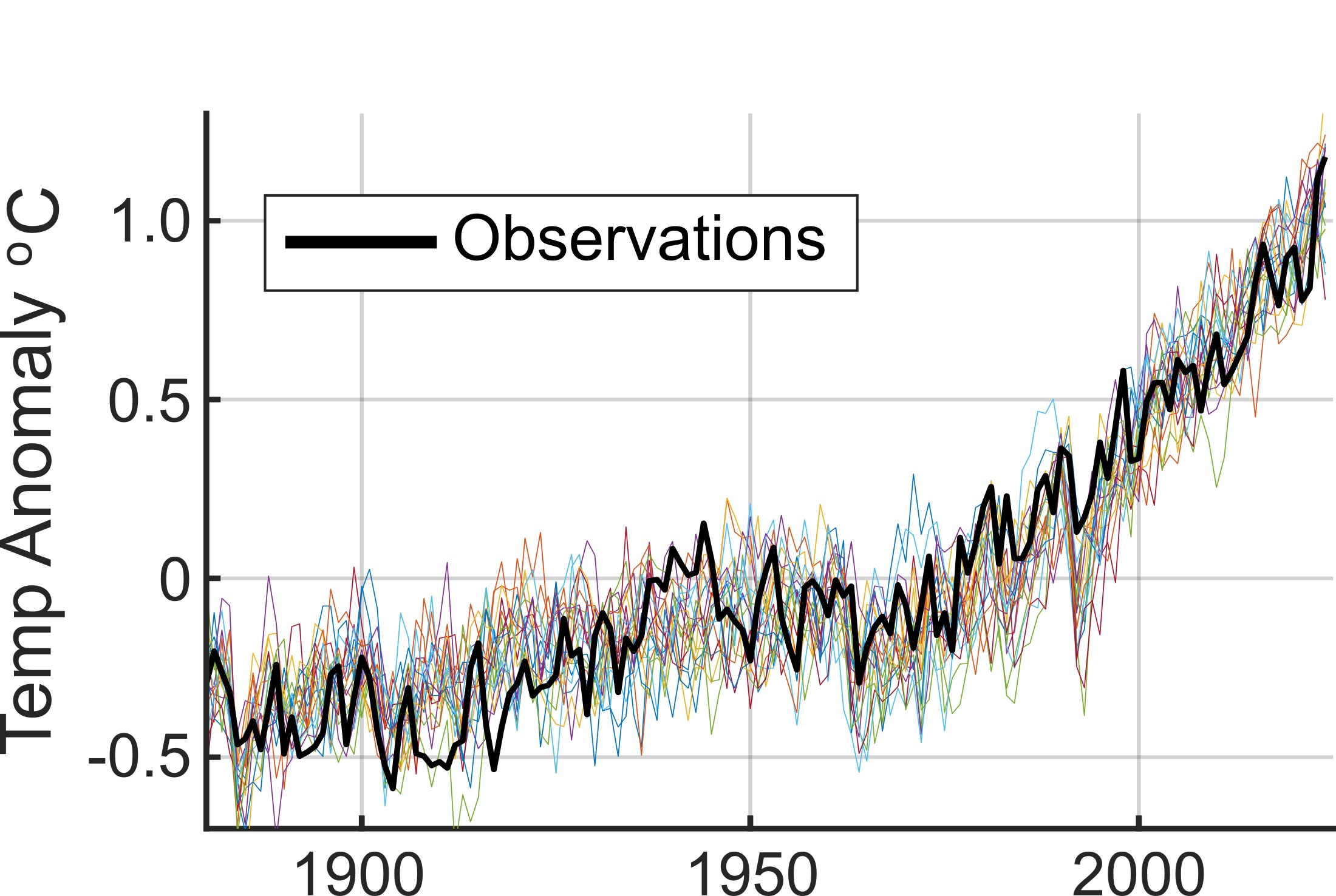
So Mann and colleagues set out to test whether the surge in temperatures really defied explanation. A new study, published in Proceedings of the National Academy of Sciences, argues that the record warmth was entirely consistent with expectations on a warming planet: When accounting for human-caused warming alongside natural climate variability like El Niño and La Niña climate patterns, the 2024 temperatures actually showed that climate models today are capturing the ongoing warming of the planet well.
Modeling the ‘Multiverse’
To untangle how much of the 2024 heat came from human-caused warming versus the natural push and pull of El Niño and La Niña—the recurring Pacific climate cycle that temporarily spikes or suppresses global temperatures—Mann’s team used a modeling technique that combined real-world temperature observations with climate model results to generate 40,000 synthetic climate simulations, essentially creating tens of thousands of alternative versions of climate history. Mann calls this creating a sort of “climate multiverse,” where human-caused warming remains constant across all simulations, but unpredictable events like El Niño and La Niña get randomized.
The simulations showed that 2024’s record-setting heat was far from an anomaly. When accounting for human-caused warming, the researchers estimated it had roughly a 12 percent probability of occurring—i.e. it could be expected to occur on average once in eight years. Strip out the baseline of human-caused warming from the models entirely, and the picture changes; in all 40,000 simulations without this signal, temperatures as high as those seen in 2024 didn’t even appear once.
“There has been a lot of discussion recently about whether the extraordinary warmth of that year means something unexpected is happening in the climate system, including suggestions that models can’t explain what we’re seeing,” says co-author Xueke Li, an assistant professor at City University of Hong Kong who was formerly a research associate at Penn. “Our results show that recent record temperatures would have been extremely unlikely without human influence—but they are entirely consistent with expectations from global warming.”
The findings offer a strong vote of confidence for current climate models, which have long incorporated the warming response to human-generated carbon pollution as a core input. Mann says they’re is a clear signal that human-caused warming is now the most dominant force shaping our climate—without it, those temperature highs from two years prior would have been essentially impossible.
“One of the most important conclusions of the paper is that climate models are doing their job, at least when it comes to the overall warming of the planet” Li adds. “Rather than contradicting climate models, the 2024 temperature spike—and the ability of the models to explain it–actually reinforces their credibility.”
Those models also point to what’s coming. Forecasters currently estimate a 60-70% chance of a new El Niño emerging in mid-2026. “When—not if—another big El Niño happens, we shouldn’t be surprised when the 2024 record is broken,” says co-author Byron Steinman, a professor at the University of Minnesota Duluth and formerly a postdoctoral researcher in Mann’s lab.
Urgency and Agency
Mann cautions that as strong as today’s models are, they may not be capturing some features of climate change like the potential for rapid ice sheet disintegration or prolonged heat waves, flooding, and drought caused by an increased tendency for a stalled, wavy summer jet stream. These features of climate change may actually be worse than current model projections suggest.
But, he adds, that uncertainty is no cause for paralysis, and the same models that flag these risks also point toward a reason for hope: “One thing the models tell us with greater confidence now is that the warming of Earth’s surface will cease shortly after we reduce our carbon emissions to zero.” Mann adds, “There’s urgency, but there’s agency too,”.
Ultimately, Mann says he wants to push back against the creeping tendency to sensationalize climate science in ways that, however well-intentioned, can undermine public trust and breed what he calls “doomism.” Overstating the mystery of events like 2024 feeds the narrative that scientists are either hiding something or don’t know what they’re doing, neither of which is true, Mann says. “The truth is bad enough. We don’t have to invent or exaggerate the gravity of the climate threat to establish the case for urgent action.”
