by Michael E. Mann
[this is the original version of a commentary the author wrote for China Daily with hyperlinks intact]
The year 2024 was the hottest year yet. As our research team recently showed, the record warmth was virtually impossible in the absence of human-caused warming. But, with a modest assist by El Niño, it was made all-too likely by our continued burning of fossil fuels.
The World Meteorological Organization recently stated that there is an 86% likelihood that this record too will be broken within the next five years. And with another El Niño event brewing in the tropical Pacific, we could in fact see that new record as early as next year. The warming of the planet will proceed as long as we continue to generate carbon pollution through the burning of fossil fuels for energy and transportation.
Global average temperatures are an abstract concept however. We do not “feel” them. What we experience, instead, is the impacts of that warming through, for example, the amplifying role it plays in the ongoing onslaught of damaging and dangerous extreme weather events we are witnessing.
Whether it’s the stifling record May heat we experienced a couple weeks ago in my hometown of Philadelphia Pennsylvania (America’s birthplace), and this past week in Europe, or the deadly floods and landslides in central and southwestern China in recent days, the consequences of climate change are now upon us.
Climate science deniers like to cite scientific uncertainty as a reason not to take action. But the cost of inaction is far greater. And uncertainty is not our friend. Our own research has shown that climate models are likely underestimating the impact that climate change is having on these extreme weather disasters. They are likely also underestimating the potential for ice sheet disintegration, sea level rise, and deadly typhoons.
The question is no longer whether or not climate change is a threat. The question is how bad we’re willing to let that threat get. The case for urgency is clear.
But the case for agency— that it’s not too late to act—is just as important, and just as clear. A recent study (which was widely mispresented by opponents of climate action) showed that the efforts underway to transition toward clean energy are paying dividends. The world is making real progress in lowering climate emissions. Whereas a worst-case emissions scenario a decade ago pointed toward a catastrophic warming of 4-5C by the end of the century, it’s closer to 3.5-4C now. A “business-as-usual” scenario where no further policy action is taken would likely lead to ~3C warming—considerably less than what we were facing just a decade ago, thanks to the policy progress we’ve made.
But that’s still a very dangerous level of planetary warming, which will lead to potentially irreversible climate impacts. We’ve made progress, it’s still not nearly enough.
Part of the problem is the fact that the U.S., which was once leading on climate, is now backsliding severely under its current leadership. The bilateral agreement between China and the U.S. during the Obama era set the stage for the highly successful Paris global climate agreement in 2016.
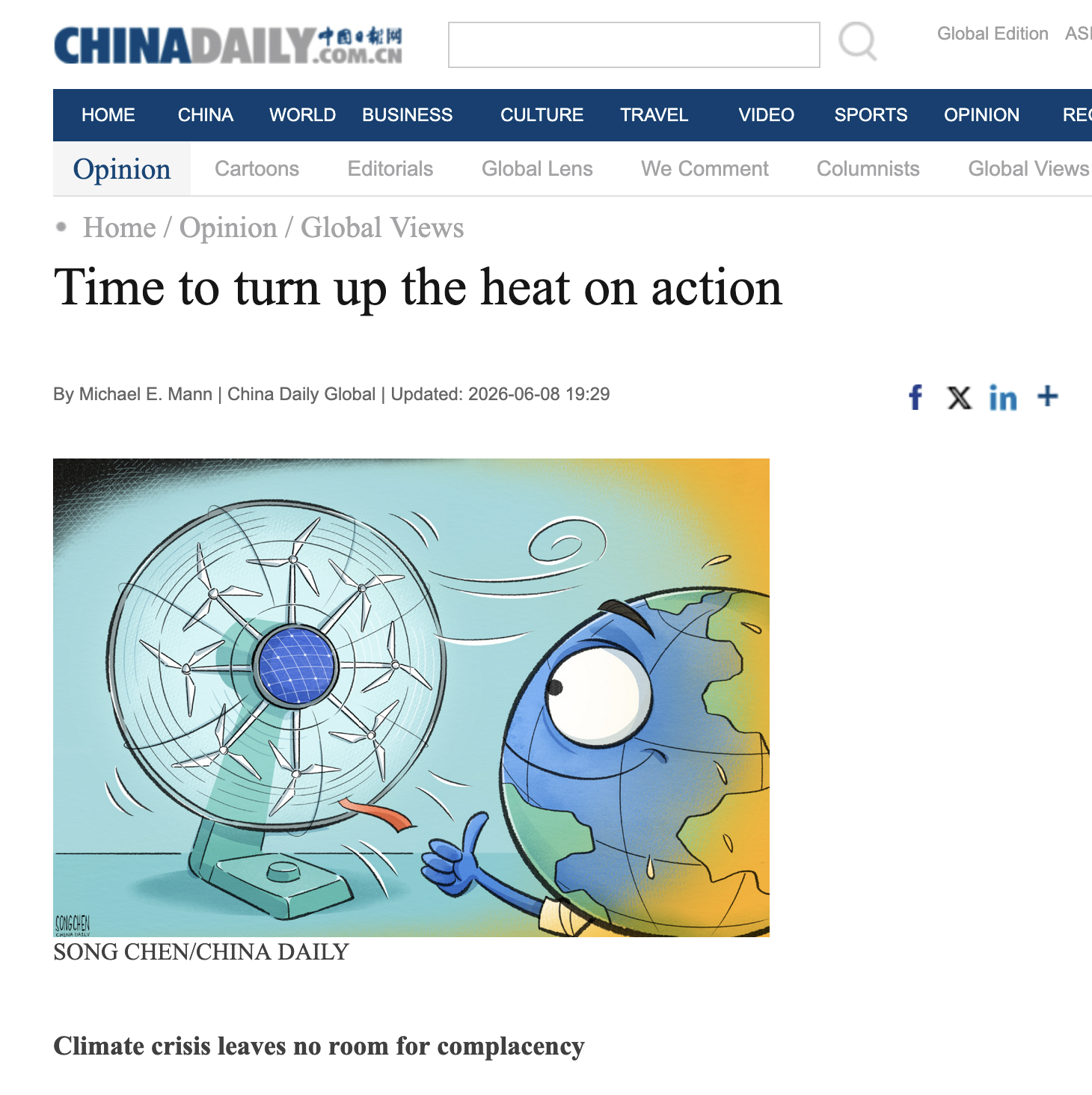
Since then, only China has made good on its end of the bargain. It promised back in 2014 to peak its emissions by 2030. It hasn’t just met this goal, It has exceeded it years ahead of schedule. Driven by an unprecedented surge in renewable energy deployment including wind, solar, batter technological, EVs and high-speed rail, China’s carbon emissions have entered a “flat or falling” trend, far ahead of the 2030 deadline.
This past year, renewable energy was responsible for nearly 86% of added power generation and reached nearly 50% of installed power capacity worldwide. The leading American scientific journal, Science, named the renewable energy surge as the 2025 Breakthrough of the Year. It singled out China’s role: “”China’s mighty industrial engine is the driver. After years of patiently nurturing the sector through subsidies, China now dominates global production of renewable energy technologies.”
Yet the U.S. is moving in the opposite direction, with the Trump administration and its Republican enablers spurning global climate agreements, partnering with bad actor petrostates like Saudi Arabia and Russia, and doubling down in fossil fuel extraction while sabotaging clean energy efforts.
The U.S. once prided itself as a source of technological innovation. But that honor has instead now shifted to China. Chinese auto company BYD’ recently announced that their EVs could be charged to 97% in only 12 minutes, putting the U.S. fleet of electric vehicles to shame. The Chinese all-electric (and largely now renewable-driven) bullet trains are breaking records both for usage (4 billion passenger trips last year) and speed (350 km/h / 216 mph). Meanwhile, the U.S. national rail service, Amtrak, long underfunded and under assault from fossil fueled-Republicans— languishes with aging equipment. What passes for its “high speed” fleet, the Acela, struggles to maintain speeds of 132 km/h / 82 mph.
The United States is no longer conductor of the bullet train that is the global clean energy revolution. It must decide whether it climbs on board or gets left behind at the station, a decision that rests substantially with voters in next year’s midterm elections and the subsequent presidential election. The rest of the world—and China in particular–must meanwhile remain resolute in moving toward a global clean energy economy. The stakes are simply too great.
Michael E. Mann is Presidential Distinguished Professor of Earth and Environmental Science at the University of Pennsylvania. He is author of “Our Fragile Moment” and “The New Climate War” (both of which have been translated to Chinese).
